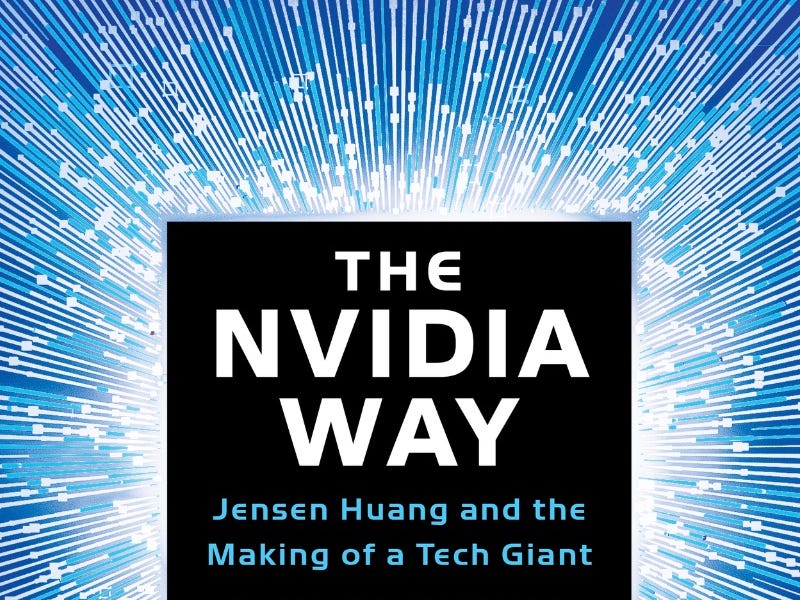
Belatedly posting a few notes on the first history of Nvidia; amazingly none had been written before this one coming which came out in December 2024. We’d all heard the stories of Huang’s intensity, 50+ direct reports, etc. but stories of the relentless execution and risk-taking is really the stuff of legends, and this was worth a read. I just wished Kim had tried to answer the ‘why’ behind Huang’s drive a bit more.
Work ethic
Every student was required to work every day. Already strong enough for extended manual labor, Jensen’s brother was assigned to work at a nearby tobacco farm. For his part, Jensen was on janitorial duty for his three-story dorm. “I had to clean the bathrooms,” he said. “You can’t unsee that kind of stuff.”
“People with very high expectations have very low resilience. Unfortunately, resilience matters in success,” he later said. “Greatness is not intelligence. Greatness comes from character.” And character, in his view, can only be the result of overcoming setbacks and adversity.
To Jensen, the struggle to persevere in the face of bad, and often overwhelming, odds is simply what work is. It is why, whenever someone asks him for advice on how to achieve success, his answer has been consistent over the years: “I wish upon you ample doses of pain and suffering.”
Landry mentioned to Jensen that some employees were griping about the long work hours. His response was typically direct. “People who train for the Olympics grumble about training early in the morning, too.” Jensen was sending a message: long hours were a necessary prerequisite for excellence. To this day, he has not deviated from that view or altered Nvidia’s expectation that employees adopt extreme work habits.
Strategy & planning
“Strategy is not words. Strategy is action,” he said. “We don’t do a periodic planning system. The reason for that is because the world is a living, breathing thing. We just plan continuously. There’s no five-year plan.”
Jensen saw more promise than peril in these explosive fights, too. He called them examples of “honing the sword.” Just as a sword only becomes sharper when it meets grinding resistance, the best ideas always seemed to come from spirited debate and argument, even if the back-and-forth could get uncomfortable. Already, he was learning to embrace conflict rather than shy away from it—a lesson that would eventually come to define his philosophy at Nvidia.
Jensen would start every new project by designating a leader, or a “Pilot in Command” (PIC), who would report directly to Jensen. He found that this created far more accountability—and a far greater incentive to do a job well—than did the standard divisional structure. “We always have a PIC for every project. Whenever Jensen talks about any project or any deliverables, he always wants the name. Nobody can hide behind, ‘such and such a team is working on that”
General lore
Sequoia met with Nvidia’s cofounders two more times in mid-June. At the last meeting, they decided to invest. “Wilf says to give you money. Against my better judgment, based on what you just told me, I’m going to give you money. But if you lose my money, I will kill you,” Valentine told the Nvidia team.
After leaving Stanford to join Nvidia, Dally kept in touch with Ng. They got together over breakfast one morning, and Ng revealed his work with Google Brain. He described successfully demonstrating how deep-learning theory could be applied to a real-world problem: the automated recognition of objects in photos, without human tagging or intervention. Ng detailed his approach of combining the extensive dataset of YouTube clips with the raw power of tens of thousands of traditional processors. Dally was impressed. “That’s really interesting,” he said. Then he made an observation that would change the trajectory of artificial intelligence. “I bet GPUs would be much better at doing that.”
“Deep learning is going to be really big,” he said at an executive team meeting in 2013. “We should go all in on it.”
Great interview of the author by Ben Thompson
There’s a Jony Ive thing that always I remembered where he was like, “The most selfish thing you can do is not be honest”, and he was like, “People have a bad idea or they do a bad job and you don’t want to hurt their feelings”, he was like, “Who are you actually helping there? You’re just trying to protect yourself from having to make someone feel bad”. And he was like, “At Apple, we don’t do that”
So there’s this thing called top-five email, which has been around since the 1990s and it’s a concept where Jensen hated status reports because they get sanitized. The manager writes a report of what’s going on and the manager’s manager sanitizes it, and by the time the CEO gets it, there’s nothing negative in the report, it’s useless. So he created this thing where every employee should email their team, their manager, and it actually gets to Jensen through distribution lists and sometimes directly, the top five most important things that are happening right now. So it might be what they saw in the market that week, what a competitor did, what they’re working on, problems they’re seeing, big new technology, innovations or papers, just email that to your friends and your team members and Jensen see it. And Jensen samples 100 of these every day and he gets a sense of what people are working on and where Nvidia is going.
 Ernest Oppetit
[…] The first history of Nvidia; amazingly none had been written before this one coming which came out in December 2024. We’d all heard the stories of Huang’s intensity, 50+ direct reports, etc. but stories of the relentless execution and risk-taking is really the stuff of legends, and this was worth a read. I just wished Kim had tried to answer the ‘why’ behind Huang’s drive a bit more. My notes here. […]
LikeLike