
I’ve been following Dan Wang for years, and read a couple of his annual letters about China. When I saw his first book was coming out, I jumped on it as I have always found his approach really interesting. He mixes policy, societal and political analysis with very ‘on the ground’ first-hand observations about life in China. This was an excellent read, and I wanted to remember a bunch of things from it, so here is gasp my first and only book notes post of 2025! Enjoy.
Introduction
- “A strain of materialism, often crass, runs through both countries” (the US and China)
- “Europeans have stuck of optimism only about the past, stuck in their mausoleum economy, because they are too sniffy to embrace American or Chinese practices”
- “China’s leaders are driven by intense paranoia, doing everything they can to control the future”
- Western commentary fixates on Beijing, so under-appreciates the dynamism of China. Would be like commenting on the US by only looking at Washington DC
1: Engineers vs Lawyers
- “While China was building the future, America had become physically static, its innovations mostly bound up in the virtual and financial worlds”
- Capitalist, social, neoliberal labels no longer make sense
- Capitalist America intrudes on free market through heavy regulation & taxation
- Socialist China detains union organizers, levies light taxes, threadbare safety net. Conservative socially (huge barriers to immigration, traditional gender roles)
- 3/4s of Chinese people pay no income tax, no property tax. People expect less of the state as a result
- Xi: “We must avoid people getting lazy from their sense of entitlement to welfare”
- Xi studied Chemical engineering. China politbureau is filled with execs from aerospace and weapons industries.
- Tools of social control (much less powerful today but still critical to central planning)
- “Danwei”: your work unit through which state allocates housing, goods, food rations etc
- “Hukou”: your household registration, which ties your education & housing benefits to a specific location (so you don’t have everyone move to the city)
- “Chinese peasants, your name is misery” Sun Dawu
- Engineering state looks at people as aggregates, not individuals
- Infrastructure efficiency comparisons
- Beijing -> Shanghai train: built in 3 years from 2008 to 2011 for $36b
- SF -> LA train: started in 2008, latest completion estimate 2033 (25 years later), latest budget $128b
- US offshore wind example
- 2023, US added 6 GW, China 76. 21 GW awaiting environmental review in US
- eg Cape Wind offshore wind project in Massachussets: 16 years of lawsuits / NIMBY then abandoned
- US becoming a lawyer-run procedural society “democracy by lawsuit”
- 400 lawyers per 100k people, 3x more than European average
- From the 60s, law schools led fights against defense industry (e.g war in Vietnam), racial discrimination, urban planners uprooting neighbourhoods, industry regulators cosying up to industrial groups (e.g oil companies spilling)
2: Building big
- Chinese leaders expected to administer a poor province before they can be promoted to the top country-level roles. They also rotate across regions to avoid drawing their power base from one home province
- Chongqing, 32M people megacity = wartime capital → socialist heavy industry → 1997 mega-municipality built for Three Gorges + Western development → 2000s hyper-urbanisation → 2010s political spotlight → today’s inland manufacturing/logistics super-node

- China has a longer high-speed rail network than the rest of the world put together
- Urban population has grown by average of 16M people each year since 1978. Housing built to match
- Material improvements generate pride and satisfaction, living conditions improved within lifetimes
- China has the capacity to produce 60M cars per year (2/3rds combustion), worldwide market is 90M sold per year today (half in China)
- Every province wants to be a hub. 100+ automotive brands in China
- China now burns more coal than the rest of the world combined
- Overbuild in some cases, eg Guizhou region has 45 of the world’s 100 highest bridges, and massive debt burden. Public official emprisoned in consequence
- Reckless construction: 5000 children killer from Sichuan region 2008 earthquake
- Supply-side vs demand-side regulation
- China focuses more on supply-side: manufacturers with preferential financing, public projects
- US focused on regulating demand, e.g rent control, mailing out Covid stimmy checks
3: Tech power
- Foxconn is Taiwanese and formal name is Hon Hai Precision Industry
- Shenzhen network of suppliers and know-how. Birthplace of BYD, DJI, Huawei
- Chinese architecture has built-in obsolescence demanding frequent renewal. Belgian Sinologist Simon Leys “Eternity should not inhabit the building, it should inhabit the builder“. Similar to Japanese practice, eg Shinto temples made of wood & hay rebuilt every 20 years
- Importance of maintaining the corresponding workforce / craftspeople to make this philosophy work. China has 100M people in manufacturing, 8x the US
- Xi repeatedly prioritising real-world economy and denouncing financialisation and ‘fictitious’ economy. Capped finance industry salaries to $400k in 2024
- US examples of the opposite: Boeing, Intel losing their way due to loss of manufacturing talent, National Security Administration no longer able to produce “Fogbank” material
- “Catfishing” – introduce a powerful creature (Tesla) into domestic environment to make Chinese firms swim faster
- Let Tesla own its plants in Shanghai, contrary to most other companies requiring JVs
- Result is BYD now as competitive as Tesla
- The Industrial Party, a Chinese online movement of techno-nationalists, fans of Chinese sci-fi like Three Body Problem
- Wang wonders: “are they simply reinventing fascism?”
4: One child
- “The pursuit of population control has forged the essence of China’s modern engineering state”
- Over 35 years of the one-child era, China performed 321M abortions and sterilized 108M women and 26M men. More than 150k children were sent abroad for adoption, around half to the US, almost all girls
- Inertia to end it, as the policy was employing over 500k workers, 1.2M local enforcers, 6M village officials, and it collected $200b in fines over its lifetime
- Guan County “childless hundred days”, or “slaughter of the lambs” in 1991
- Policy from Zeng Zhaoqi to have 0 births in the county for 100 days as his county was behind on quotas
- Child smuggling. “In 2004, twenty-four baby girls in tote bags were found on a long-distance bus, drugged to keep them quite, bound for adoptive families”
- The roots of the one-child policy were set by Song Jiang a nuclear scientist. Wang makes the case that if there was a healthy social sciences field & debate, the one-child policy would not have happened. In the West, the Population Bomb (1968) triggered these debates but no such policy was applied
- Now looking to reverse and encourage natality. By 2100, China’s population is projected to halve to 700M
- Marriage less appealing now: only 40% of divorce applications are granted by a judge
- Illegal for unmarried women to freeze their eggs, vasectomies very hard to get
5: Zero-Covid
- “Before Soviet-trained engineers refashioned Beijing for monumentalism, the French built Shanghai for pleasure”
- Chinese Communist Party was founded in 1921 in the French Concession in Shanghai
- In Shanghai, Covid testing was mandatory at least once per day. Getting everyone out of their appartment to go do tests in the lobby, likely increasing contact risk
- Covid was the third epidemic with the same pattern, i.e trying to kill the news / silence whistleblowers
- 1990s Henan province AIDS outbreak due to a blood bank reusing needles and comingling blood
- 2003 SA~RS outbreak
- 2000 Wuhan officials directed the police to punish medical whistleblowers, such as Li Wenliang the ophthalmologist who blew the whistle and died in Feb 2020.
- Yunnan region has about half of officially recognised minorities, historically resisted rule by the dominant Han group. Techniques such as shifting root crops (growing underground crops that are harder to count the production of) to reduce tax collection
- Zero-COVID policy ended abruptly in December 2022 after widespread protests and rapid policy change.
6: Fortress China
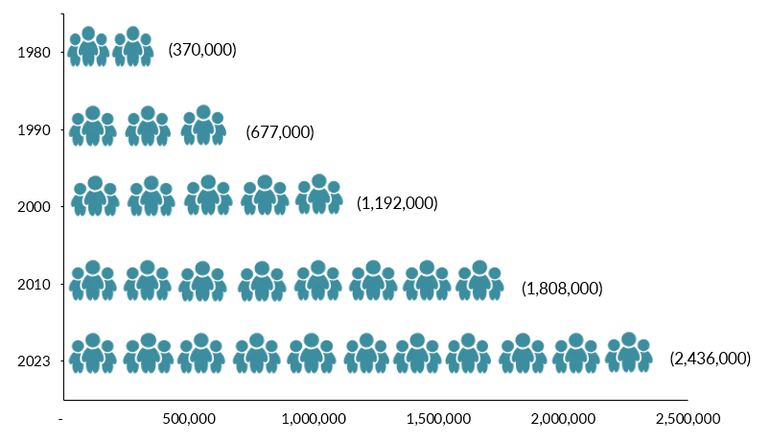
- Half of this Chinese immigration to the US is to California, New York
- 38k Chinese nationals aimed to cross the US southern border in 2024
- Xi regulatory storm on tech in 2021
- Trillion dollars of market value wiped out, e.g Alibaba lost 75% of its size, New, Oriental education company lost 90% value, Ant Financial IPO cancelled
- No strong legal protections so not even rich people were well protected
- “The chief justice of China’s supreme court publicly denounced the idea of judicial independence, an action that elevated the party above the law”
- “Sometimes, the only thing scarier than China’s problems are Beijing’s solutions”
- Very few global cultural hits from China relative to its size. Suggested cause is overzealous censorship: comedy troupes have to submit scripts to censors weeks before etc.
- Renminbi accounts only for 3% of global payments
- Belt and Road Initiative. $1T spent in 150 countries.
- Start of his third term, Xi declared China’s great historical problem was its lack of technology. Qing empire besieged by “Western ships and their cannons”. Xi declared China must be a “science and technology superpower” by 2035.
- Latest 5 year plan on science & technology: deep space exploration, base on the Moon by 2030, polar exploration
- Trade restrictions imposed by US on the top-range chips helped Beijing’s self-sufficiency agenda
- Military & manufacturing capacity comparisons
- In 2022 China had 1,800 ships under construction, the US had 5
- Jake Sullivan: the US will experience “exhaustion of munition stockpiles very rapidly” if it were to face the Chinese military
- UN group predicts China will have 45% of the world’s industrial capacity by 2030. Today the US, Europe, Japan, South Korea, Taiwan and all other high-income states combined add up to 38% capacity
7: Learning to love engineers
- Wang’s parents sometimes feel regret, they emigrated to the US just as China’s economic boom began in earnest
- Celebrating the wonders built by the US, eg Admiral Hyman Rickover, directed the original development of naval nuclear propulsion
- Great quote 🙂 “Entering a subway station in Manhattan feels too often like descending into a rotting pit, where one stands amid trash and worrisome leaks, until a deafening metallic screech announces the train”
- Law prof Grant Gilmore: “The worse the society, the more law there will be. In hell there will be nothing but law, and due process will be meticulously observed.”
- Pluralism is what gives Wang hope about the US – provides potential for course correction
Further resources
In conversation with Steven Kotkin:
 Ernest Oppetit