
Intro
- “The Iron Law of Megaprojects”. 99.5% of projects go over budget, over schedule, under benefits, or some combination of these
- The California high-speed rail project was voted in a referendum in 2008. It was to be ready for 2020 with a cost of $33b. In 2023, the estimate was $100b+ with no clear end in sight, and significantly descoped
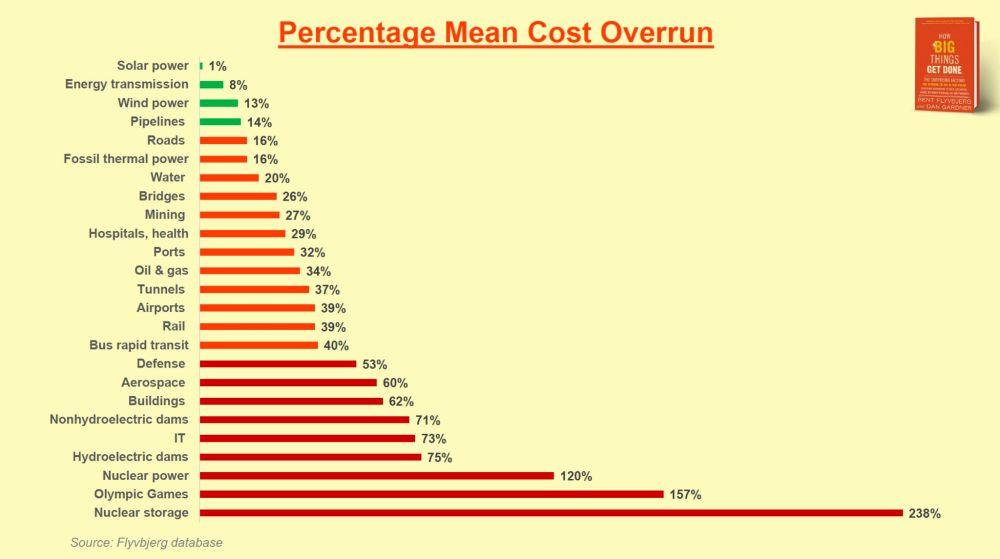
- Other disasters: Boston’s Big Dig (16 years and 3x budget). James Webb telescope (4.5x over budget). Sydney Opera House (10 years late and 13x over budget). IT projects too: Healthcare.gov. NHS website. Every Olympic Games since 1960 for which data are available has gone over budget (157% over on average)
- Successful large projects are the exception. The Hoover Dam. The Empire State building. It was built in 18 months, on time and on budget. What can we learn from them?
Think slow, act fast
- Default today is rush to start construction, then have a super long construction cycle with delays (“break-fix cycle). The opposite needs to be done: long planning / derisking and fast construction.
- The distribution of risk in megaprojects is fat-tailed. When it goes wrong it can go really wrong. Fat tail distributions are common in complex systems, which megaprojects are embedded in (cities, markets, transport, etc).
- The longer your project is in construction, the more chance there is some external unexpected factors to badly influence it (natural disaster, pandemic, scandal, etc.). You need to keep construction as short as possible
The commitment fallacy
- “Premature lock-in”. Everyone locks-in to the current path ahead although there are better alternatives.
- Pervasive overconfidence and optimism in talking about schedules. Kahneman showed this too, we are always too optimistic
- Hofstadter’s Law: it always takes longer than you expect, even when you take into account Hofstadter’s Law.
- There is a bias against planning. Planning is working. “Bias for action” from Bezos has caused damage here.
- “Strategic misrepresentation” the tendency to deliberately and systematically distort or misstate information for strategic purposes
- “We always knew the initial estimate was under the real cost. Just like we never had a real cost for the Central Subway or the Bay Bridge or any other massive construction project. So get off it. In the world of civic projects, the first budget is really just a down payment. If people knew the real cost from the start, nothing would ever be approved” – Willie Brown, a former San Francisco mayor and California state assemblyman
Think from right to left
- The projects should not be the goals in themselves. Should do ‘backcasting’ thinking about the desirable end goals and then seeing how projects fit in. PRFAQ from Amazon is a good tool here.
Pixar planning
- Frank Gehry practices “think slow, act fast” and has a great reputation for delivering on-time and on-budget. eg for Guggenheim Bilbao, heavy use of CAD and simulation early.
- Planning has a bad reputation. Experiri in Latin is “to try”, “to prove” and led to “experiment” and “experience”. These may be better terms to use.
- Pixar turn movie ideas into storyboards.
- “Once there is a decent script in hand, Pixar does something unusual: The director and a team of five to eight artists turn the entire script into detailed storyboards that are photographed and strung together into a video that roughly simulates the movie to come. With each storyboard covering about two seconds of film time, a ninety-minute movie requires approximately 2,700 drawings. Dialogue read by employees is added, along with simple sound effects.“
- This is not cheap, but a lot cheaper than going to full production. Helps derisk earlier
- “Maximum virtual product“. The CAD representation of the building, or the very detailed storyboard.
Are you experienced?
- Highly experienced project leaders like Frank Gehry and Pete Docter (Pixar CEO) overflow with tacit knowledge about the many facets of the big projects they oversee. They are masterbuilders
- Tacit knowledge we feel, but cannot always explain. “We know more than we can tell” – Michael Polanyi. Similar to Aristotle’s phronesis (practical wisdom).
So you think your project is unique?
- Reference-class forecasting. It is more reliable to estimate costs/budget using historical data of similar projects (the “outside view”) than trying to do it ‘bottom-up’ yourself (the “inside view”)
- This way of forecasting works the best. It captures the unknown unknowns and negates our optimism bias
- Based on Kahneman and Tversky theories
- Flyvbjerg created a database of projects to help with this
Can ignorance be your friend?
- There are exceptions of projects that turned out well without planning, and these are glorified: Hendrix studio Electric Layland, the Jaws movie, etc. But these are exceptions and not statistically representative
A single, determined organism
- Heathrow T5 is an example of a well delivered project. “Think slow, act fast” and:
- Full ownership of the whole project by one organisation
- Performance and deadline-based incentives with contractors
- Giving staff psychological safety, and making them feel pride on the project
What’s your lego
- “Repetition is the mother of learning”
- “Following this line of reasoning, I advised a company building a large nuclear power plant to duplicate exactly what it had done in building a recent plant, not because the earlier plant had been a great success but because even that degree of repetition would boost them up the learning curve. Every little bit helps.“
- “Manufacturing in a factory and assembling on-site is far more efficient than traditional construction because a factory is a controlled environment designed to be as efficient, linear, and predictable as possible. To take an obvious example, bad weather routinely wreaks havoc on outdoor construction, while production in a factory proceeds regardless of the elements.”
- “Scale-free scalability”. With a modular design and good base process, you can scale up infinitely
- “Only five project types—solar power, wind power, fossil thermal power, electricity transmission, and roads—are not fat-tailed, meaning that they, unlike all the rest, do not have a considerable risk of going disastrously wrong. So what sets the fortunate five apart? They are all modular to a considerable degree, some extremely so.“
Eleven heuristics for better project leadership
- Hire a masterbuilder. They have the phrenesis (practical wisdom) to make it happen
- Get your team right
- Ask “why?”
- Build with lego. Modularity, big is best built from small.
- Think slow, act fast.
- Take the outside view. Use reference-class forecasting.
- Watch your downside.
- Say no and walk away. “Innovation is saying no to 1000 things”
- Make friends and keep them friendly.
- Build climate mitigation into your project.
- Know that the biggest risk is you (and your biases).
Misc
- “Given the amount of digging HS2 would require, that was a major risk. The solution? Put every qualified archaeologist in the country on a retainer.”
- “For want of a nail, the shoe was lost. For want of a shoe, the horse was lost. For want of a horse, the rider was lost. For want of a rider, the battle was lost. For want of a battle, the kingdom was lost.” “a little neglect may breed great mischief.” – Ben Franklin
 Ernest Oppetit
[…] Why megaprojects are almost always over time and over budget, and what we can do about it, including for smaller projects. My notes here […]
LikeLike